

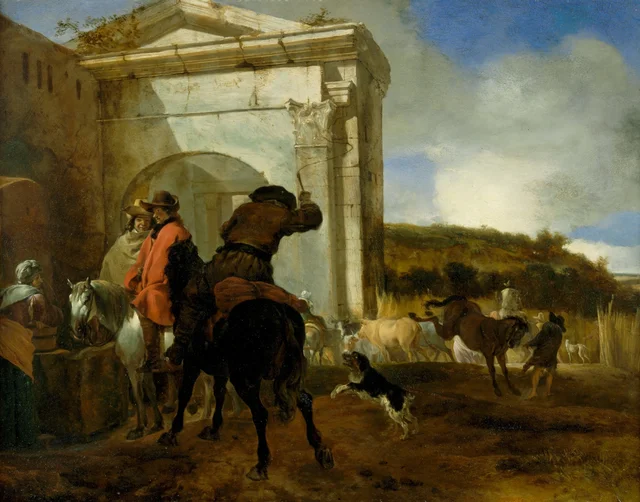
Italian Landscape with Inn and Ancient Ruins, 1658.
Italiaans landschap met herberg en antieke ruïnes (museum title)
Jan Baptist Weenix (Dutch), oil on wood
Mauritshuis, Netherlands

13 works held in 8 museums
Dutch Golden Age painter, 1621-1659
Italiaans landschap met herberg en antieke ruïnes (museum title)
Jan Baptist Weenix (Dutch), oil on wood
Mauritshuis, Netherlands

Jan Baptist Weenix (Dutch), oil on canvas
Detroit Institute of Arts, United States

Jan Baptist Weenix (Dutch), oil on canvas
Cleveland Museum of Art, United States

Jan Baptist Weenix (Dutch), oil on canvas
National Gallery of Ireland

Dode patrijs, hangend aan een spijker (museum title)
Jan Baptist Weenix (Dutch), oil on canvas
Mauritshuis, Netherlands

Portret van René Descartes (1596-1650) (museum title)
Jan Baptist Weenix (Dutch), oil on canvas
Centraal Museum, Netherlands
Italiaans landschap met ruiters bij een bron (museum title)
Jan Baptist Weenix (Dutch), oil on copper
Centraal Museum, Netherlands

Jan Baptist Weenix (Dutch), oil on canvas
Detroit Institute of Arts, United States

Jan Baptist Weenix (Dutch), oil on canvas
Museum Boijmans Van Beuningen, Netherlands

Jan Baptist Weenix (Dutch), oil on canvas
Städel Museum, Germany

Italiaans havengezicht (museum title)
Jan Baptist Weenix (Dutch), oil on canvas
Centraal Museum, Netherlands

Stilleven met dood wild en gevogelte (museum title)
Jan Baptist Weenix (Dutch), oil on canvas
Centraal Museum, Netherlands

Hamn med antika ruiner (museum title)
Jan Baptist Weenix (Dutch), oil on canvas
Nationalmuseum, Sweden
Works by Jan Baptist Weenix (1621-1659), in the public domain, each linked to the record of the institution that holds it. Born in Amsterdam and a pupil of Bloemaert in Utrecht, he lived in Rome from 1642 to 1647, where he painted for Cardinal Pamphili, the future Innocent X; he brought back the landscapes of ancient ruins, the busy Mediterranean harbours and the scenes of Italian country life that made him one of the masters of Italianate painting, before turning, towards the end of his life, to large hunting still lifes. He also painted a few portraits, among them that of René Descartes. Only works that the institutions give to him without reservation, and of which a freely reusable photograph exists, are included; the origin of each photograph is given on the page of the work. The titles are those of the institutions, with their translation.